
Topic: Weather & ClimateWord 14 of 41
flood Meaning in Korean (flood 영어 뜻)
noun · verbnoun
홍수
verb범람하다, 쇄도하다
유의어:범람넘침쇄도
홍수 in English:flood
IPA:ˈfloʊd
Plural: floods
Quick Answer • 요약
Flood의 한국어 뜻은 홍수, 범람하다, 쇄도하다입니다. (물이 정상적인 범람선을 넘어, 특히 평소에는 마른 땅인 곳을 덮는 것.)
Concept Illustration
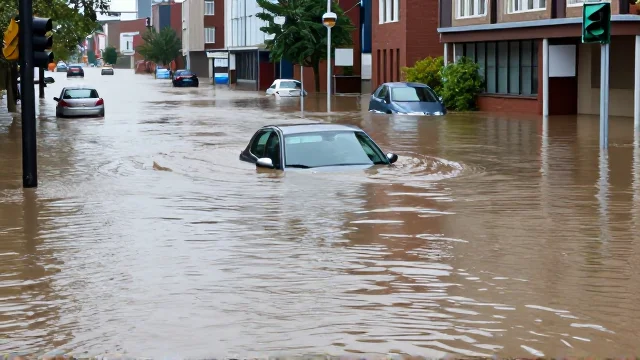
Visual representation of "flood"
Definitions of Flood
- 1홍수noun
An overflowing of a large amount of water beyond its normal confines, especially over what is normally dry land.
물이 정상적인 범람선을 넘어, 특히 평소에는 마른 땅인 곳을 덮는 것. - 2범람하다verb
To cover or submerge (an area) with water.
(지역을) 물로 덮거나 잠기게 하다. - 3쇄도하다verb
To arrive in overwhelming quantities or amounts.
압도적인 양이나 수로 도착하다.
Example Sentences
Synonyms (유의어)
In Korean:
범람넘침쇄도
In English:
delugeinundationtorrent
Topics & Categories
Topic & Explore💡Usage & Grammar Note
주로 명사로 쓰이며, 동사로도 사용됩니다.
Inflected Word Forms
third person singularfloods
past tenseflooded
present participleflooding
Phrases & Idiomatic Expressions
a flood of lightexpression
A sudden, overwhelming amount of light.
a flood of emotionsexpression
An overwhelming surge of feelings.
flood the marketcollocation
To supply a market with an excessive amount of a product.
Frequently Asked Questions: Flood in Korean
What is the meaning of Flood in Korean?▼
Flood의 한국어 뜻은 홍수, 범람하다, 쇄도하다입니다. (물이 정상적인 범람선을 넘어, 특히 평소에는 마른 땅인 곳을 덮는 것.)
How do you translate 'Flood' to Korean?▼
'Flood' translates to '홍수' in Korean. Flood의 한국어 뜻은 홍수, 범람하다, 쇄도하다입니다. (물이 정상적인 범람선을 넘어, 특히 평소에는 마른 땅인 곳을 덮는 것.)
What is '홍수' called in English?▼
'홍수' in English is called "Flood". Flood refers to: 물이 정상적인 범람선을 넘어, 특히 평소에는 마른 땅인 곳을 덮는 것.
How do you pronounce 'Flood' and '홍수'?▼
Listen to clear English audio pronunciation of 'Flood' (IPA: /ˈfloʊd/) and native Korean audio speech for '홍수' with bilingual sentence examples on DictBridge.
What is an example sentence for Flood in Korean?▼
English: "The heavy rain caused a severe flood in the low-lying areas." | Korean: "폭우로 인해 저지대에 심각한 홍수가 발생했습니다."
Related Words in Weather & Climate
Explore contextually related English vocabulary with verified Korean meanings, pronunciations, and sentence usages: